В тази статия
- Quick answer
- Understand what the wall changes
- Record a useful starting position
- Move forward before moving sideways
- Make a shelf behave less like an enclosure
- Handle corners and uneven boundaries
- Use port bungs and boundary controls correctly
- Adjust height and angle after bass placement
- Finish with restrained equalization
- Sources
Quick answer
Start with the minimum wall clearance specified in your speaker manual, then move both speakers forward in small, equal steps while replaying familiar music at a comfortable volume. Measure clearance from the rear cabinet or port opening, not from the front edge. Keep rear ports unobstructed, bring the front baffles ahead of surrounding shelf edges, and avoid placing either speaker directly in a corner when possible.
If bass remains heavy, try a manufacturer-approved boundary setting or supplied port bung before applying large equalizer changes. Keep the arrangement that makes voices clearer without stripping away useful bass. There is no universal distance that suits every bookshelf speaker, wall, and listening position.
Understand what the wall changes
A nearby wall changes how direct and reflected sound combine. Depending on speaker placement and listening position, some bass notes become stronger while others become weaker. This is why moving a speaker a short distance can improve one recording yet make another sound less even. A wall is not simply adding the same amount of bass at every frequency.
Rear ports introduce an additional practical requirement: their openings need the clearance recommended by the manufacturer. However, a front port does not make a speaker immune to wall effects. Sealed speakers also interact with boundaries. Treat port location as one placement consideration rather than a guarantee that a particular cabinet will work anywhere.
Record a useful starting position
Before moving anything, note the distance from each cabinet to the rear wall, nearby side wall, and listening seat. Mark the current positions with removable tape if the surface permits. Photograph the arrangement so you can restore it. Keep the volume, listening seat, and playback settings unchanged during the first comparisons.
Choose three short passages: a clearly recorded speaking voice, music with a steady bass line, and something with a stable central vocal. Avoid judging everything from a single deep note. Listen for understandable words, consistent bass notes, and a centered voice. These are subjective comparisons, not calibrated measurements, but they are useful when the procedure stays consistent.
Move forward before moving sideways
If the manual permits the starting position, pull both speakers forward by roughly five to ten centimeters and replay the same passages. Repeat only while the furniture remains secure and cables retain slack. Moving both speakers together makes the comparison easier because you are changing one main variable rather than altering stereo balance simultaneously.
Do not assume that more distance always sounds better. A different position can trade a bass peak for a cancellation. Stop when the overall balance improves across several passages, not when one note sounds impressive. If space is severely limited, compare the original position with the largest safe forward move and then investigate boundary controls rather than endlessly making tiny adjustments.
Make a shelf behave less like an enclosure
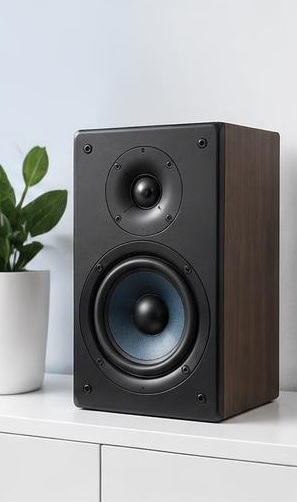
A bookshelf speaker can work on furniture, but a deep cubby adds nearby reflecting surfaces and may restrict port airflow. Where practical, position the front baffle at or slightly ahead of the shelf edge. Keep books, ornaments, and cabinet doors away from the drivers and port. Do not let an object rest against the cone or grille.
Use stable, appropriately sized isolation pads if vibration is reaching the furniture. Pads may reduce mechanical vibration, but they cannot remove room-related bass peaks. Confirm that the shelf supports the speaker's weight and that the cabinet cannot slide or tip. Avoid improvised tall stacks of foam, especially around children, pets, or frequently used desks.
Handle corners and uneven boundaries
A speaker beside both a rear wall and a side wall often behaves differently from its partner beside an open doorway. Try moving the corner-side speaker slightly farther from the side wall while preserving a sensible listening triangle. If the layout allows, make the surroundings more similar before adjusting electronic balance.
Keep notes about which change improves voices and bass at the actual seat. Perfect visual symmetry is not always possible, and equal tape-measure distances do not guarantee identical acoustics. However, large differences in surrounding surfaces can create persistent imbalance. Avoid correcting a narrow bass problem by simply turning one entire speaker down; that also reduces its midrange and treble.
Use port bungs and boundary controls correctly
Some speakers include foam port bungs or a wall-placement setting. Follow the model's instructions, including whether the bung should be inserted fully or used in stages. These options change bass behavior and may make a close-wall location more practical. They are not interchangeable across every design, so do not copy settings from a different speaker.
Never stuff a port with clothing, loose foam fragments, or household objects. A port may be part of a carefully designed acoustic system, and improvised material can lodge inside. If the manufacturer provides no port-blocking guidance, ask support before experimenting. Photograph the original settings, compare at the same listening volume, and retain only changes that help across varied material.
Adjust height and angle after bass placement
Once the wall distance is workable, arrange the speakers so their intended listening axes point reasonably toward seated ear height. The manual may specify a particular axis or orientation. Use secure stands or suitable furniture rather than balancing a speaker on its edge. Keep both speakers oriented as the manufacturer intended.
Try modest toe-in changes while listening for a stable central voice and clear consonants. Excessive toe-in can make some speakers sound too bright, while too little may weaken focus. Change the angle equally at first. If the sound changes sharply when you move your head, also inspect nearby reflective surfaces such as a bare desktop or television panel.
Finish with restrained equalization
After placement is settled, use a small bass reduction or the manufacturer's room-control feature if the balance still feels heavy. Avoid large boosts intended to fill a deep cancellation; they can consume amplifier headroom without reliably improving the seat. If your system includes automated correction, follow its microphone-position instructions and rerun it after meaningful placement changes.
Save the final distances and settings so the setup is repeatable after cleaning or moving furniture. Judge the result over several ordinary listening sessions rather than one dramatic demonstration. If no practical position works, speakers designed for boundary placement or a different support arrangement may be a better solution than increasingly extreme processing.
Sources
Consult the exact model's clearance, mounting, port-bung, and boundary-control instructions before applying generic placement advice. Manufacturer guidance takes priority over suggested trial distances.
Official support and manuals: kef.com guidance ; genelec.com guidance ; svsound.com guidance