Quick answer
Small rooms force compromises, but a deliberate layout usually works better than placing speakers wherever a shelf happens to be empty. Begin by identifying your main listening position and practical limits: doors, walkways, screens, power outlets, and furniture that cannot move. Measure the room and sketch two possible arrangements before buying stands or acoustic panels.
In diesem Artikel
- Start with a workable listening area
- Build left-right symmetry where possible
- Set height and aiming deliberately
- Manage front-wall distance without a universal rule
- Move the seat as well as the speakers
- Reduce desk and shelf interference
- Treat reflections with realistic expectations
- Handle the subwoofer as a separate placement problem
- Test changes methodically and keep the best compromise
- Sources
Start with a workable listening area
Small rooms force compromises, but a deliberate layout usually works better than placing speakers wherever a shelf happens to be empty. Begin by identifying your main listening position and practical limits: doors, walkways, screens, power outlets, and furniture that cannot move. Measure the room and sketch two possible arrangements before buying stands or acoustic panels.
The objective is balanced direct sound and manageable room interaction, not strict obedience to one placement formula. A nearfield arrangement can help by keeping you relatively close to the speakers, but it does not remove bass room modes. Leave safe cable routes and adequate ventilation, and use stands or furniture that can support the speakers securely without becoming a tipping hazard.
Build left-right symmetry where possible
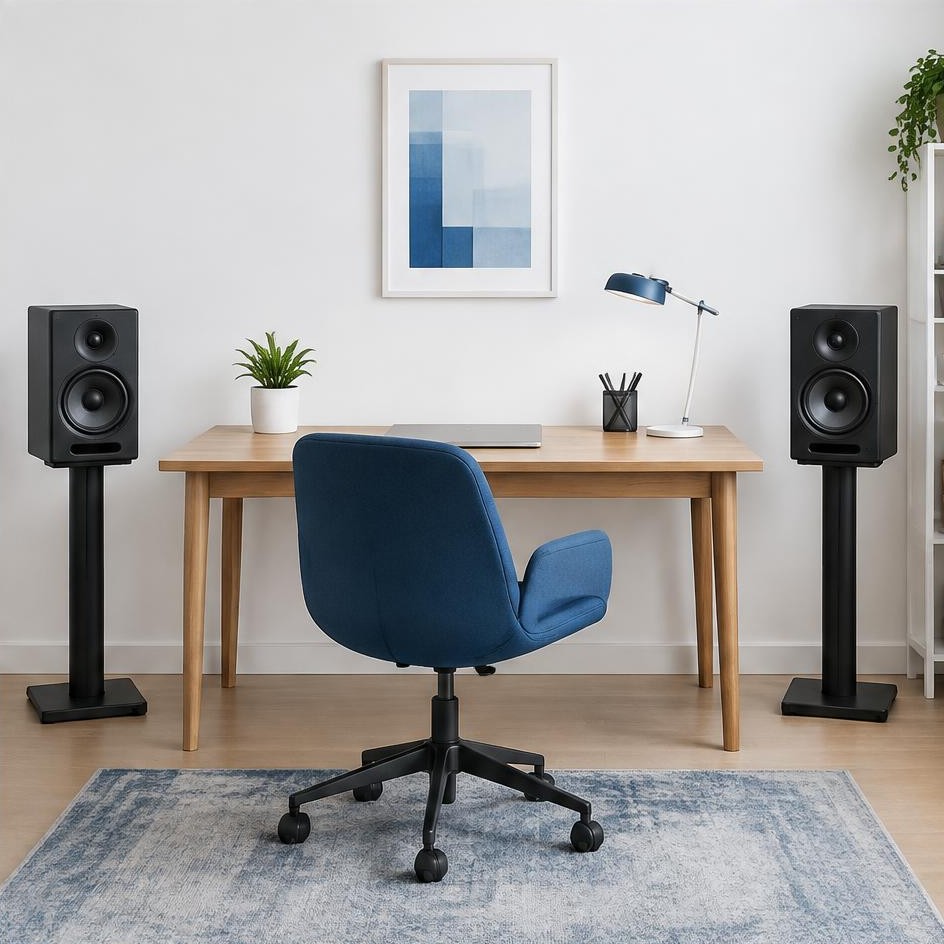
Place the listening position and speaker pair around the room's left-right centerline when practical. Try to give the speakers similar distances to side boundaries. One speaker tightly beside a wall and the other next to an open doorway can produce unequal reflections and tonal balance. Symmetry is especially useful for stable central voices and predictable stereo imaging.
Genelec recommends a symmetrical arrangement and a sixty-degree angle between the left and right monitors at the listener, corresponding to an equilateral triangle. genelec.com guidance Treat that as a starting point: the distance between the speakers should roughly match the distance from each speaker to your head. In a compact room, bringing the whole triangle closer may be more practical than spreading it wider.
Set height and aiming deliberately
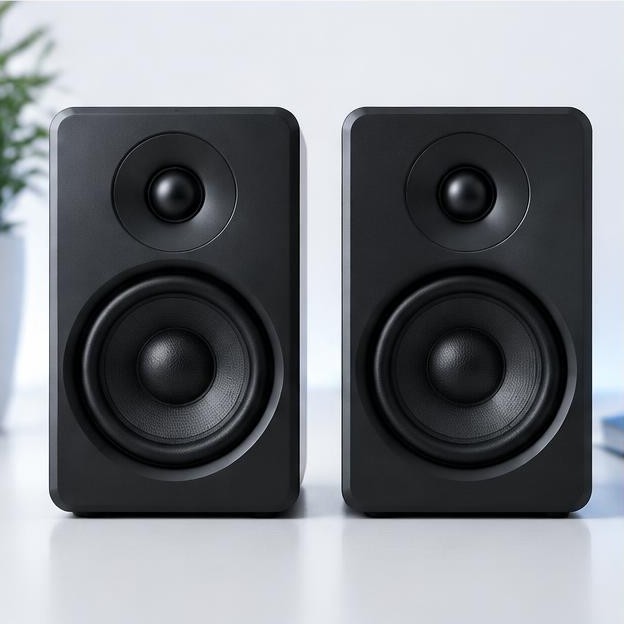
Follow the speaker manufacturer's guidance for the acoustic reference axis, often near the tweeter. Aim to place that axis near seated ear height. Use suitable stands or stable supports rather than balancing speakers on loose objects. Keep both speakers at matching heights unless the manufacturer explicitly designs the system for another arrangement.
Start with equal toe-in toward the listening position, then adjust both speakers in small matching steps. Some speakers are intended to face directly toward you; others work better with less toe-in. Judge the center image and tonal balance with familiar speech and music. Avoid laying a vertically designed two-way speaker on its side unless the manufacturer permits it, because dispersion can change.
Manage front-wall distance without a universal rule
The wall behind the speakers can reinforce bass and create frequency-dependent cancellation through reflections. There is no single correct distance for every speaker and room. Start with the manufacturer's recommendations, including port clearance, ventilation, and mounting requirements. A rear port does not automatically make wall placement impossible, but it does require the clearances the designer specifies.
In very small rooms, placing speakers relatively close to the front wall may be more workable than leaving an arbitrary large gap. The resulting boundary reinforcement may need an approved boundary setting or careful equalization. Move the pair in small increments and compare at the same level. Record distances from the cabinet fronts or another consistent reference so the experiment is repeatable.
Move the seat as well as the speakers
A listening position against the rear wall often experiences strong bass irregularities, and the exact center of the room can also be problematic. Genelec advises avoiding the room's exact center and keeping the listening position away from walls where space allows. genelec.com guidance In a small domestic room, its ideal clearances may be impossible; improve what you can rather than abandoning the layout.
Play a familiar passage with several bass notes quietly and compare two or three seat positions. Move forward or backward before changing electronic settings. A modest shift can alter a pronounced peak or dip. Do not raise bass gain to compensate for a missing note until you have checked whether that note returns at a neighboring position.
Reduce desk and shelf interference
A broad desktop can reflect sound toward your ears shortly after the direct signal. Speakers pushed far back behind a monitor also encounter obstructions and nearby surfaces. If practical, put them on independent stands beside the desk, or use stable desktop stands to achieve suitable height and aiming. Keep the path between each speaker and your ears unobstructed.
Move the speakers toward the desk's front region where practical, without creating an unstable overhang. Keep their geometry symmetrical around the display. Isolation pads may reduce some vibration transmission or help with aiming, but they do not erase room modes or every desktop reflection. Before buying accessories, compare the sound with loose desk objects removed and the speaker positions adjusted.
Treat reflections with realistic expectations
Hard surfaces can create strong early reflections, while suitable absorptive treatment can reduce them. A rug, upholstered furniture, and substantial curtains may improve an otherwise bare room, especially at mid and high frequencies. Thin foam or fabric should not be described as effective deep-bass treatment. Low-frequency absorption generally requires substantial depth or purpose-designed systems.
Genelec explains that thin porous layers primarily reduce high-frequency reflections and that small rooms usually benefit more from absorption than diffusion. genelec.com guidance Use purpose-made products with appropriate mounting and fire-safety information. Avoid covering every surface indiscriminately: a room can become dull at high frequencies while retaining uneven bass. For serious problems, consult an acoustics professional before making expensive permanent changes.
Handle the subwoofer as a separate placement problem
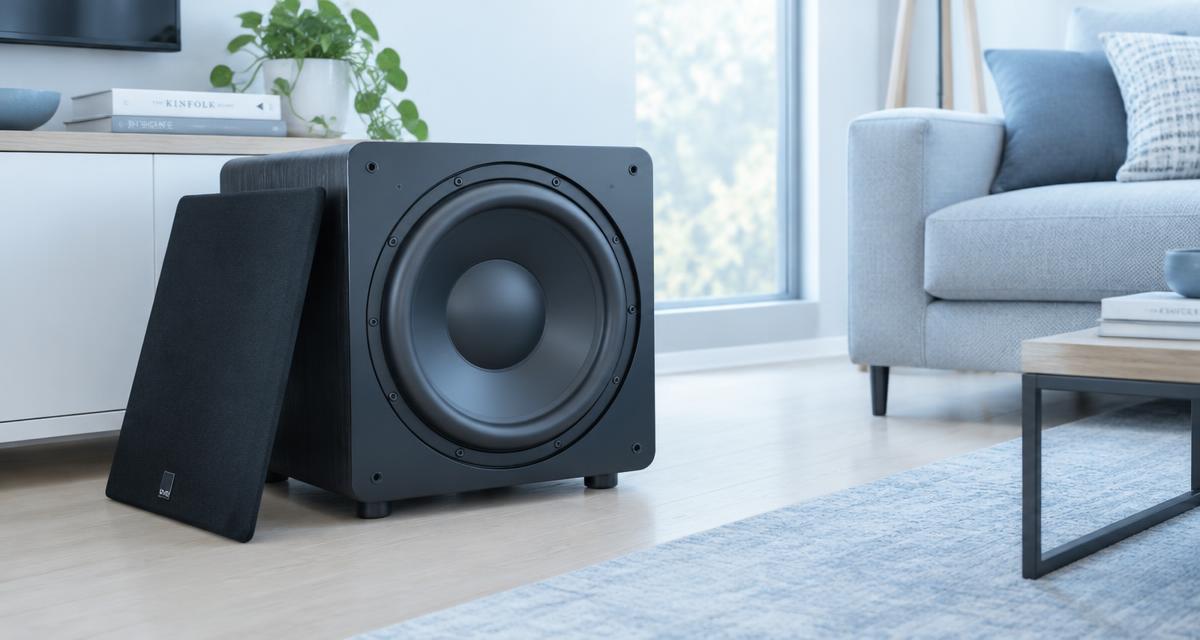
A subwoofer need not occupy the same position that works best for stereo imaging. Its relationship to room modes and the listening area matters more than visual symmetry alone. Genelec suggests a position along the front wall, slightly off the left-right centerline, as one starting approach while emphasizing trial and measurement. genelec.com guidance
Compare practical locations at a consistent level rather than choosing the one that produces the loudest single note. Keep ports and vents clear, and maintain safe access to cables and controls. Once the location is reasonably smooth, revisit crossover, level, and timing. Moving the subwoofer after detailed alignment can change the result enough to require another setup pass.
Test changes methodically and keep the best compromise
Change one variable at a time and mark useful positions with removable tape. Keep a short log of speaker spacing, wall distance, toe-in, and seat location. For detailed comparison, use a suitable measurement microphone and measurement software rather than assuming a browser sweep is calibrated. Confirm improvements with normal listening across the seats you actually use, then stop rearranging when the remaining tradeoffs are acceptable.
Sources
Genelec, Studio Monitor Placement: genelec.com guidance
Genelec, Improving Room Acoustics: genelec.com guidance
Genelec, Subwoofer Placement and Bass Management: genelec.com guidance