Quick answer
A crossover divides frequency responsibilities between speakers and a subwoofer. In a typical bass-managed system, a high-pass filter reduces low bass sent to the main speakers while a low-pass path sends bass toward the subwoofer. These are gradual transitions, not brick walls. Around the selected frequency, both sources may contribute, so their levels and timing determine whether the handoff sounds smooth.
Dalam artikel ini
- Understand what the crossover is doing
- Separate three commonly confused controls
- Choose one primary bass-management stage
- Pick a sensible starting frequency
- Understand small, large, and stereo-system limitations
- Set placement and level before fine tuning
- Check timing and phase around the handoff
- Use measurements for a difficult transition
- Verify with normal listening and save the setup
- Sources
Understand what the crossover is doing
A crossover divides frequency responsibilities between speakers and a subwoofer. In a typical bass-managed system, a high-pass filter reduces low bass sent to the main speakers while a low-pass path sends bass toward the subwoofer. These are gradual transitions, not brick walls. Around the selected frequency, both sources may contribute, so their levels and timing determine whether the handoff sounds smooth.
The goal is not simply more bass. A successful setup produces consistent bass notes without an obvious hole or excessive hump near the transition. It can also reduce the low-frequency burden on smaller speakers. Before adjusting anything, identify which component performs bass management and read the receiver, processor, amplifier, and subwoofer manuals for the intended connection method.
Separate three commonly confused controls
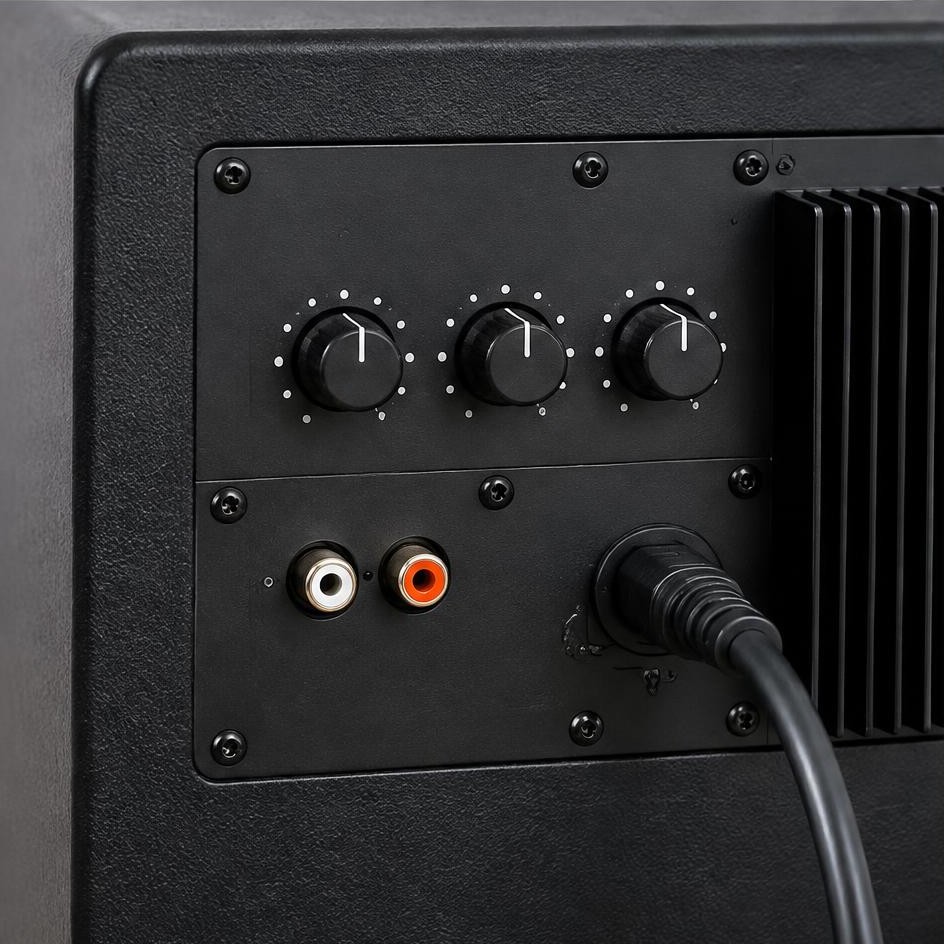
A receiver's speaker crossover determines how bass is redirected from ordinary speaker channels. The subwoofer's low-pass control limits what its amplifier reproduces. An LFE low-pass setting applies to the dedicated low-frequency effects channel in compatible soundtracks. These controls may show similar frequency numbers, but they do not necessarily operate on the same signal.
Genelec distinguishes bass management from the LFE channel and identifies the LFE bandwidth as extending to 120 Hz. genelec.com guidance Do not automatically set an LFE filter to the same value as an 80 Hz speaker crossover. Follow the processor's guidance so you do not unintentionally remove content from the effects channel.
Choose one primary bass-management stage
When an AV receiver performs bass management, its subwoofer output normally already contains the required filtered and redirected bass. The subwoofer may provide an LFE input or a way to bypass its own low-pass filter. Use the manufacturer-recommended arrangement. If bypass is unavailable, the manual may recommend the highest low-pass setting to minimize unintended overlap between filters.
Two active low-pass stages can alter both level and phase around the handoff. That can create a result different from the receiver's intended crossover. Do not assume turning both controls to 80 Hz produces a correct 80 Hz system. Photograph or note existing settings, then establish a clean baseline using one clearly identified crossover controller.
Pick a sensible starting frequency
For many home systems, 80 Hz is a useful starting point rather than a universal answer. SVS identifies it as a common recommendation while giving higher starting ranges for smaller speakers. svsound.com guidance Compact satellites may need a substantially higher crossover; capable larger speakers may integrate well lower. Cabinet size alone does not settle the choice.
Use the speaker's clean bass capability, manufacturer guidance, room behavior, and intended listening level. A published extension figure without a tolerance is weak evidence. If the receiver's automatic setup recommends a higher crossover than expected, do not immediately lower it for appearance's sake. A low setting can leave a small speaker reproducing bass that it handles poorly.
Understand small, large, and stereo-system limitations
On many receivers, Small and Large describe bass-routing behavior rather than physical size. Small typically enables bass redirection using a crossover. Large often sends a full-range signal to that channel. Exact behavior varies, especially with settings labeled LFE plus Main or Double Bass. Read the manual before enabling options that may duplicate bass through both speakers and subwoofer.
A two-channel amplifier may send full-range sound to the speakers even when a subwoofer is connected. In that arrangement, the subwoofer's low-pass knob does not create a high-pass filter for the mains. You are blending the subwoofer with their natural roll-off unless another component provides filtering. Do not assume a subwoofer output guarantees complete bass management.
Set placement and level before fine tuning
Choose a practical subwoofer location before spending time on detailed crossover adjustments. Placement strongly affects room modes, so moving the cabinet later can invalidate earlier work. Genelec notes that wall or corner placement increases output, but the smoothest response depends on modal excitation. genelec.com guidance A louder location is not automatically the most balanced location.
Follow the equipment's setup procedure for the subwoofer gain control and receiver level adjustment. If automatic room setup is available, use its supplied microphone and prescribed positions. Avoid setting gain simply by making every bass note impressive. Begin with a restrained balance and use familiar recordings with varied bass notes to judge continuity rather than impact alone.
Check timing and phase around the handoff
Main speakers and subwoofers can partially cancel around the crossover when their acoustic outputs arrive with an unfavorable relationship. A polarity switch changes the sign of the signal; a variable phase control and a delay or distance adjustment behave differently. They are not interchangeable versions of one universal correction. Follow the component's documentation for which adjustment should be used.
Receiver distance values may include processing delay, so a subwoofer's reported distance need not match a tape measurement exactly. Do not overwrite an automatically determined value solely because it looks physically wrong. For an informal check, compare brief familiar passages at the listening seat after changing only one setting. Avoid choosing a setting merely because one sustained note becomes loudest.
Use measurements for a difficult transition
A suitable measurement microphone and software can separate main-only, subwoofer-only, and combined responses. Keep the microphone fixed while comparing candidate settings. A dip in the combined response near the crossover can suggest an integration issue, but room cancellations and filtering also matter. Use the measurement application's timing procedures rather than guessing from the magnitude curve alone.
Room EQ Wizard documents the required input, output, level, and measurement preparation. roomeqwizard.com guidance A browser tone generator alone cannot calibrate crossover alignment or acoustic level. Keep sweeps conservative and within the equipment's operating range. If a driver knocks, scrapes, or distorts, stop rather than raising gain to obtain a clearer trace.
Verify with normal listening and save the setup
Check music and dialogue-supported scenes at ordinary listening levels, including neighboring seats. Listen for consistent bass pitch, a stable soundstage, and the absence of a conspicuous transition. Document crossover, gain, phase, distance, and placement. If the result remains uneven, revisit location before adding boosts. Integration is usually a sequence of small controlled improvements, not one perfect frequency value.
Sources
Genelec, Subwoofer Placement and Bass Management: genelec.com guidance
SVS, Tips for Setting the Crossover Frequency of a Subwoofer: svsound.com guidance
Room EQ Wizard, Making Measurements: roomeqwizard.com guidance